Renxiang Liu (Wuhan University)
Article information
Liu, Renxiang. “Prescience and Patience: A Reassessment of Technoscience in Light of Heidegger.” Studia Phaenomenologica, 24 (2024): 165–180. https://doi.org/10.5840/studphaen2024249
Published open-access by Zeta Books under CC BY-NC-ND 4.0.
Full text link: https://zetabooks.com/wp-content/uploads/SP24_Liu_OA.pdf
Abstract
In this paper, I respond to contemporary debates on technoscience by asking about how science and technology are fusible. This directs me to Heidegger’s critique of calculative thinking in modern technology and science: it turns things into objects of representation so that they may be ordered and manipulated. The unilateral availability of objects for the subject is achieved by attending to what Heidegger called the “mathematical” in things, i.e., conceptual schemes pre-delineated before encountering things. To imagine an alternative, I transform the phenomenological account of temporality into a thing-centric account of the unfolding of things at their own rhythms. What matters is to be patient for such rhythms, to enter a relation of mutual availability. This is in effect becoming the paradigm in contemporary practices of technoscience. The inquiry shows what is problematic (prescience) and what is promising (patience) in the technoscience that is still taking shape in our age.
Keywords
Technoscience, calculative thinking, object of representation, the mathematical, rhythms of unfolding.
1. Introduction: Disentangling Technoscience
Since the words “science” and “technology” entered daily discourse, they have been perceived as designating two closely intertwined yet different aspects of our engagement with the world. The task of science is to know about things in the world, especially about the regularities according to which they perform, while technology is about operating on them and even producing things which have never existed before. Even Bruno Latour, one of the major proponents of the intertwinement of science and technology, ascribed them to different “modes of existence” in a recent work.[1]
This makes it all the more curious as the word “technoscience” has been employed in philosophy since mid-1970s to address the further fusion of science and technology in late modernity.[2] The major concern behind is that both the subject and the object of scientific research have been reshaped when “technology becomes the milieu, the driver and the finality of research.” (Hottois 1984) On the one hand, material, social, and political agencies are at play in technoscientific practice, so that the “subject” of technoscience is no longer the Cartesian subject with a detached stance and purely cognitive intentions but rather “irreducibly plural” and engaged (Hottois 2018: 130). On the other hand, scientific objects nowadays are fabricated through “sociotechnical shaping and production”: instead of facts and laws about objects that exist independent of inquiry, technoscience “seeks to establish demonstrable capacities of construction and control by functionalizing objects, implementing new capacities and enhancing their value.” (Bensaude Vincent and Loeve 2018: 173) In other words, the fusion of science and technology in contemporary technoscience concerns a shift in the very task which scientists set for themselves.
Since technoscience cares not so much with the essence or “nature” of things than with their affordances and propensities for technological operation, it is understandable that most technoscientists are ontologically uncommitted. However, as Bensaude Vincent and Loeve point out, this does not mean that technoscience is ontology-free (2018: 178). The inquiry into how things would respond to operation presupposes an understanding (Heidegger might say “pre-understanding”) of the senses in which the thing “is” and the operation “is.” Regarding this, Hugh Lacey (2012) argues that technoscience continues to be conducted within the “decontextualized approach” and therefore inherits its ontology from “pure” science, while Bensaude Vincent and Loeve (2018: 176–180) would see technoscience as thoroughly contextualized, helping nature deliver its own, local capacities, rather than imposing a homogeneous framework on nature.
This paper continues the discussion of the ontology which is often only implicit in technoscience. However, instead of debating directly over the mode of being of technoscientific objects, it begins from the examination of an idea which contemporary discussions about the fusion of science and technology usually take for granted and thus leave undiscussed—the idea that science and technology are fusible in the first place. After all, why do scientists feel justified to take up as objects of scientific research what technology—from simple apparatuses of measurement to Scanning Tunneling Microscopy (STM) and genetic modification—offers them? To answer this question, we need to turn to earlier discussions of technoscience, even those avant la lettre:[3] there is a tradition of thought which holds that modern science has always been thoroughly intertwined with technology—in today’s vocabulary, that modern science has always been technoscience. Within this tradition, Heidegger’s reflection on technology and science stands out, as it allows us to disclose the way in which both science and technology operate temporally—that is, both seek to determine things in advance, so that they are known and manipulated as pre-delineable objects. The temporal analysis is itself not explicit in Heidegger’s words but rather often implicit in his critique of “calculativethinking” and in his characterization of the “thing” in contradistinction to the object. With a transformation of what the phenomenological tradition says about temporality, I would like to show that attending to the temporal unfolding of things at their own rhythms helps us both understand Heidegger better and shed light on the question of the fusibility of techno-science.
Thus, in the following, the formulation “techno-science” (with a hyphen) does not necessarily imply the deep and explicit fusion of science and technology that we find nowadays and which is discussed under “technoscience.” It connotes more generally that science has always been technological in that it seeks to pre-determine things as objects. While this seems an anachronism, it will help us grasp what is at stake even in contemporary debates about technoscience.
2. Heidegger on Calculative Thinking
Buckley (1992) identifies in Husserl and Heidegger a critique of the “crisis” of modern rationality, with modern science as its major embodiment. In Heidegger’s thought, the crisis is that of “calculative thinking” [rechnendes Denken], which in turn is characteristic of technology. In other words, a thought pattern which is characteristic of technology is the motivation behind science. This interpretation of Heidegger is affirmed by Dupuy (2018: 141): “science is subordinated to the practical ambition of achieving mastery over the world through technology,” though Dupuy is critical of Heidegger’s position. Thus, it would be helpful to examine what “calculative thinking” meant for Heidegger.
The words “calculation” and “calculating” are scattered through Heidegger’s article, “The Question Concerning Technology.” (Heidegger 2000) Buckley’s characterization of calculative thinking is the following:
The word “calculative” is connected to a type of thinking which is motivated by measurement, by the search for results. It finds its most powerful expression in modem science. The word calculation also connotes how this thinking aims at manipulation and control. […] this thinking of science aims not just to observe the situation, but to use its observations to make predictions, to plan for the future, to quantify in the sense of “taking stock” and thereby to keep everything in order. This thinking thus also betrays a fundamental sense of a need for certainty and security: it wants to know exactly where “things” are and precisely what “they” might be doing. (Buckley 1992: 235)
In this characterization, we find ideas which we usually associate with technology, such as manipulation, control, keeping in order, and pursuit of security. On the other hand, these ideas are constantly at work in scientific inquiries: despite the discourse of neutrality and disinterestedness, scientific research (including contemporary technoscience) pursues knowledge of worldly objects for the sake of keeping them in order.[4] The exclusion of contingent interests is for the sake of the certainty of control.
Conversely, for Heidegger modern technology is not the mere application of modern science but manifests the hidden essence of the latter: to control, order, and organize the world, to put the world into a picture [Bild] which is secure and constantly available for us. (Buckley 1992: 241) Technology and science converge on their embodiment of calculative thinking.
Calculative thinking works by way of representing, which means identifying things with objects and placing them before ourselves (as subjects) like a picture. Representing makes possible the calculation and manipulation of things, for otherwise our entanglement among things would make it difficult to manipulate them; conversely, things are turned into objects of representation for the sake of calculation and manipulation (1992: 236–237). When distinguishing between the thing [das Ding] and the object of representation [die Gegenstand der Vorstellung], Heidegger (2012: 8) noted that “science only ever encounters that which its manner of representation has previously admitted as a possible object for itself.” The emphasis was on “possible”: the knowing subject’s faculty of representation has pre-delineated what can possibly come forth and be encountered as an object. What does not fit into the pre-delineated possibilities is not thematized in science at all.
Here, we observe the critical appropriation of a Kantian theme. For Kant, the categories (i.e., the pure concepts of understanding) determine what the “objects of possible experience” are like. For Heidegger, this amounts to filtering the world of things with the sift of concepts, so that only objects of representation get through. The problem consists in the identification of the thing with the conceptual determination thereof. An example of this identification, which is prevalent in techno-science, is Putnam’s discussion of the famous twin-earth argument. While it was under debate what the intension of the word, “water,” is, Putnam had no issue pointing out that the extension of the word is H2O on earth and XYZ on twin-earth. (Putnam 1975) This implies (for instance) that the thing we call “water” on earth is identical to H2O, which in turn is a determination of the thing with scientific (in this case chemical) concepts.
Only when the thing is reduced to the representation or conceptual determination thereof can calculative thinking order and manipulate it. For thought can operate directly on concepts alone, not on the thing in all its richness and depth. However, the ordering and manipulation of things do not constitute an end in itself. Techno-science would not take every chance to manipulate them—to “boss them around,” as it were. Rather, calculative thinking exhibits “an aggressive challenging of the world to produce that which can be stored up and manipulated.” (Buckley 1992: 244) Ordering [Bestellen] and manipulation serve to turn everything into a “standing-reserve” [Bestand]: “everywhere everything is ordered to stand by, to be immediately at hand, indeed to stand there just so that it may be on call for a further ordering.” (Heidegger 2000: 17) In other words, what calculative thinking seeks to achieve is the “instant and complete availability” of everything. (Buckley 1992: 244) Such an availability is unilateral in the subject-object relation: while the object should ideally be available for the subject, i.e., always ready whenever the subject needs it, the opposite is not the case. The subject has no responsibility for the object; rather than respecting the mysteries and inner rhythms of the thing, the subject turns the thing into an object so as to impose its own rhythms on the latter.
In this section, the fusibility of science and technology is traced, in light of Heidegger’s critique, to calculative thinking. The essence of calculative thinking, then, consists not so much in ordering and manipulation (though it certainly makes use of them) than in bringing about the complete, instant, and unilateral availability of the object for the subject. We shall dwell on the notion of availability when analyzing the temporal structure of calculative thinking, which is characteristic of techno-science.
3. “The Mathematical” and the Pre-delineation of Things
The notion of availability has temporal connotations. If something is made available for us, it means that we can take it up and use it whenever we want or need to. In other words, the processes in which the thing participates with us are initiated, maintained, and (if needed) terminated according to our will, not according to the thing. A perfectly available car is a car that proceeds and stops whenever the driver wants it to. What happen with the car itself, e.g., the consumption of fuel, the wearing of the cogs, etc., should not disturb the utilization of the car. When they do obtrude, e.g., when the car runs out of fuel or when there is a mechanical breakdown, the car becomes un-available. The moment of unavailability is that of the intrusion of the car’s own rhythm. From this we know that the availability of things for us is based on a disregard for their own rhythms and contingencies, so that we withdraw from the real encounter with them (in which our rhythms would have to negotiate with theirs) and are thereby able to determine them in advance.
To examine what this “determining in advance” means, we shall now follow Heidegger’s discussion of “the mathematical” in The Question Concerning the Thing.
The first thing to note is that “the mathematical” is not found exclusively in the discipline of mathematics; nor does the notion of “the mathematical” describe thoroughly the practices in mathematics. Heidegger made a clear distinction between (a) “the mathematical” [das Mathematische] and (b) mathematics [die Mathematik] as a discipline. The latter refers to activities of measuring, calculating, and reasoning with the help of numbers, symbol for variants, formulas, and geometrical figures. The former, by contrast, is the ontological precondition of these activities, a specific “understanding of being” [Seinsverständnis]. It is the “projection” in advance of beings according to “the mathematical” which turns beings into measurable and calculable mathematical objects. In other words, “the mathematical” describes a fundamental way of formulating things, while the employment of numbers in mathematics is possible and relevant only because numbers do especially well in delineating things according to “the mathematical.” In Heidegger’s words, “mathematics is itself only a determinate formation of the mathematical.” (Heidegger 2018: 46) Clearly, the mathematical, rather than mathematics, is directly connected to the foregoing discussion of calculativethinking.[5]
To clarify what “the mathematical” means, Heidegger focused first on the notion of τὰ μαθήματα in ancient Greek thought. The notion referred to one of the ways to determine a thing. Here’s Heidegger’s list:
- τὰ φυσικά: things insofar as they originate and come forth from themselves;
- τὰ ποιούμενα: things insofar as they are produced [hergestellt] by the human hand, in craftsmanship, and stand there as such;
- τὰ χρήματα: things insofar as they are in use and stand thereby at constant disposal;
- τὰ πράγματα: things insofar as we have to do with them as such, whether we work on them, use and transform them, or merely observe, contemplate, and investigate them;
- τὰ μαθήματα. (2018: 47)
The last one, τὰ μαθήματα, named things insofar as they can be grasped before actually encountered, so that this grasping is learnable and teachable. Every being can be referred to in different aspects, and the “mathematical” aspect refers to what is graspable in advance about the being. Concerning how a grasping of τὰ μαθήματα precedes the actual encounter with the thing, Heidegger (2018: 49–50) said,
This authentic learning [of τὰ μαθήματα] is therefore an extremely remarkable taking, a taking whereby the taker only takes what he or she at bottom already has. […] He or she [the student] first comes to learn when he or she experiences what he or she takes as what he himself or she herself actually already has.[6]
When we see things as τὰ μαθήματα, what we “take” from them is not something we otherwise lack but rather something we already have. What we already have in this case is a set of conceptual schemes. We “do not first have to fetch from things” these conceptual schemes (2018: 50). When we have our ways with a thing, we only ask how it “fits” into the schemes; the schemes themselves are not “refreshed” in light of the thing. Put otherwise, we already have a set of conceptual schemes prior to encountering the thing, and we can observe from the thing only what can fit into the schemes. This mechanism of filtering and reducing makes possible our grasping of the thing prior to encountering it. This “pre-graspable” character of things is what Heidegger called “the mathematical.”
Heidegger (2018: 61–62) then traced how “the mathematical” in the above, Greek sense was embodied in Galileo’s “mathematical projection” [mathematische Entwurf]. The determination of a physical body [Körper] implied in Galileo’s notion of “mente concipere” “is not derived by way of experience from the thing itself.” What is determined in advance is rather corporeality [Körperhaftigkeit] as such: for a physical body to exist as a physical body, it must have quantifiable extension, motion, etc. This ontological determination of things via mathematizing concepts makes sure that whatever comes forth under this determination is already homogenized, measurable, and calculable:
All determinations of body are delineated in one blueprint [Grundriß], according to which the natural process is nothing but the spatiotemporal determination of the motion of points of mass. This blueprint of nature simultaneously circumscribes its domain as everywhere uniform [überall gleichmäßigen]. (2018: 62)
As it seeks to fix the “blueprint” of the thing prior to encountering it, this kind of determination is bound to yield what is “everywhere uniform” or homogenized. The things which come forth under this determination are qualitatively uniform; their mutual difference can thus only be quantitative.
In attending to “the mathematical” (i.e., what is formally pre-delineable) in things, calculative thinking is indeed able to determine things before encountering them. In techno-science, this determination-in-advance may exhibit itself either as knowing (scientific prediction) or as manipulating (technological design). Science can tell us where exactly the moon will be in the sky at a given time, because it attends to the aspect of locomotion of the moon, an aspect which is “mathematical” in the sense that it can be encountered without actually encountering the moon in its phenomenological richness: its luminance, voluminosity, texture, rhythms of occlusion and revealing, etc. Similarly, technology can design a bridge that will stand for two hundred years, even though the designer will not likely live long enough to check, two hundred years later, whether it still stands—in fact, they would not have to, for the very ideal of design is to order the “mathematical” aspect of the bridge (the structure, the distribution of mechanic forces) so that we no longer need to be attentive to what the bridge becomes in the future. In these examples, we observe both the strengths and the limits of techno-science following calculative thinking, both of which are rooted in the fact that calculative thinking, in achieving the unilateral availability of things for us, attends only to what is formally pre-delineable in things.
The limits of calculative thinking are becoming painfully evident nowadays. The most relevant one in the current context concerns the impoverishment of experience: if, in our engagement with things, we encounter only what we have imposed on them, there is a sense in which we miss them rather than encounter them. Heidegger (2018: 62–63) described the problem with the notion of “leaping over”:
As mente concipere, the mathematical is a projection of the thingness of things that, as it were, leaps over [hinwegspringen] things. […] Modern science is experimental on the basis of mathematical projection. The experimental urge toward the facts is a necessary consequence of the prior mathematical leap over [Überspringen] all facts.
4. Patience and Availability for the Rhythms of Things
The question, then, is how we imagine an alternative. An alternative to leaping over is patience. While asking for and ordering the unilateral availability of things for us, we disrespect their rhythms, expecting them to fit into our own plans at any moment. It is for this reason that we attend to “the mathematical” in them, thus missing their richness and depths of meaning. By contrast, to be patient for things means to respect their intrinsic rhythms, to be available for them in the sense of being receptive and responsive to them, as if we were participating in their growth. This is a mode of bilateral rather than unilateral availability, in which the rhythms of our action are hospitable and are ready to negotiate with those of the thing, rather than seeking to overwhelm the latter by precluding their relevance.
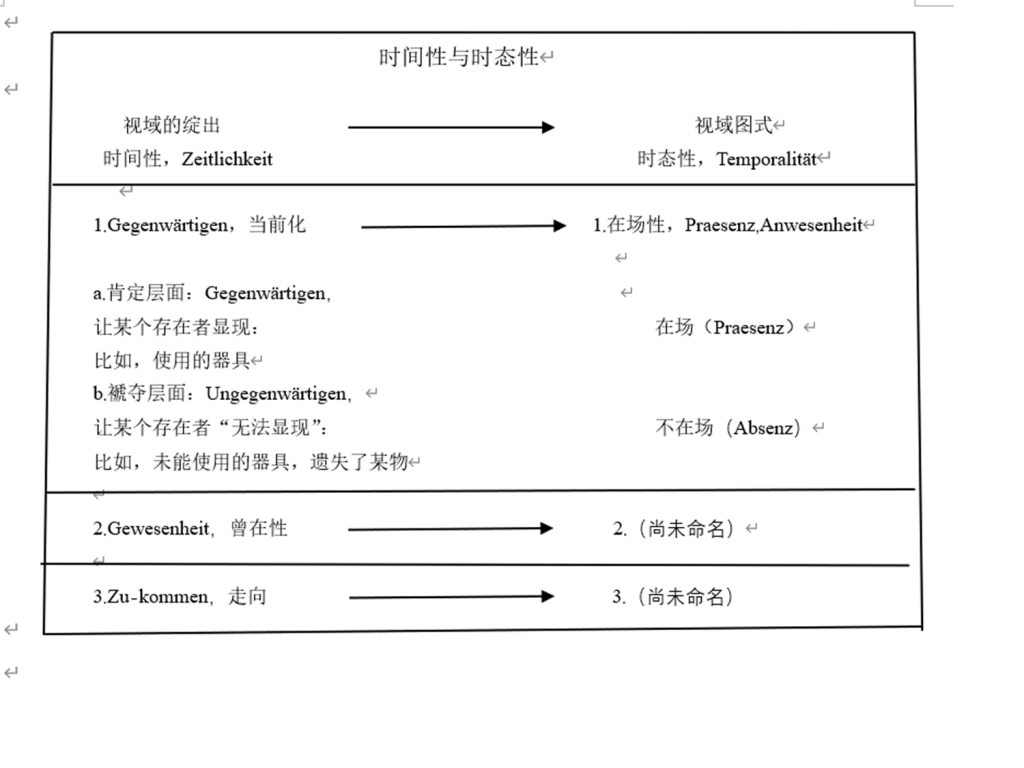
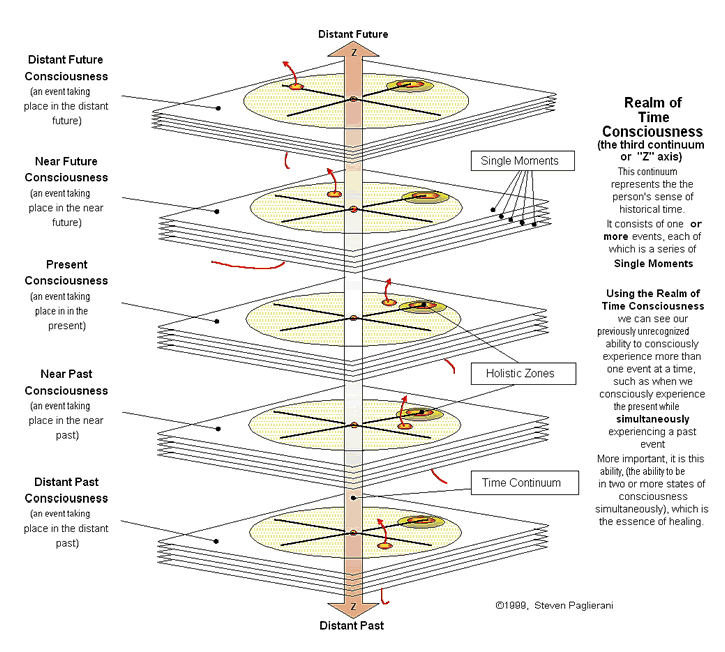
The talk of rhythms may be reminiscent of the theme of temporality in phenomenology. For example, Husserl (2001: 48) said that perception “constantly pretends to accomplish more than it can accomplish,” suggesting that the temporal unfolding of things in perception involves an interplay of completeness and incompleteness. However, there is a long-standing tradition in phenomenology to interpret temporality in terms of how experience is temporal for us.[7] In other words, the concept of temporality seems to be based on that of transcendental subjectivity; it is an aspect of transcendental subjectivity which explains the fact that we can and do experience things and events as temporal. This was even the case for the early Heidegger, though supposedly there was a shift from the transcendental to the ontological problematic (de Warren 2021: 404). Heidegger (1967: 234–235) said in Being and Time that the meaning of Dasein is temporality. Temporality remained to be defined in terms of Dasein’s “ecstatic” projection [Entwurf] into the dimensions of future, past, and present. In this way, however, there is a risk that we locate in our own subjectivity the origin of the rhythms of things. In other words, there is a risk that such rhythms lose their autonomy and alterity in the transcendental-phenomenological interpretation of temporality. To do justice to the rhythms of things, phenomenological discussions on temporality must be taken up and transformed.
We find some clues in the later thought of Heidegger. In his 1949 lecture on “The Thing,” Heidegger (2012: 15) introduced the idea that, in a genuine encounter, the thing “things” [das Ding dingt]. His direct elaboration of this was that, by “thinging,” the thing “lets the united four, earth and sky, divinities and mortals, abide in the single fold of their fourfold.” (2012: 16) Without delving into the complex topic of the fourfold [das Geviert], what is already clear here is that the thing, rather than the subject, serves as the locus or nexus of the “fold.” Instead of a temporal synthesis which is brought about by the subject, we have here a gathering (folding) which the thing enables by un-folding what is always united.
Accordingly, time is no longer understood as the temporality of the transcendental subject, not even that of Dasein, but rather as a self-extending which measures the presencing of being (Heidegger 1972: 10–16). The role of Dasein, then, is only “to respond to what comes from afar [i.e., from being itself via things] and to assume the care for that which we can never master” (Buckley 1992: 256). Such is a notion of time which is based on the mutual availability of the thing and us.
These prepare us for an ontological account of the inner rhythm pertaining to the unfolding of things, in which the primordial sense of time is the productive resistance which allows the intricacies or “folds” of things to gradually and alternately “un-fold.” The basic assumption is that things do not “have at hand” all their details. On the contrary, these details or “intricacies,” as possible, latent being, are “folded” in the “folds” of things. Only time lets these folds un-fold.
This means that things do not exist “in themselves” in a non-temporal or supra-temporal mode, only requiring time to become manifest to finite subjects like us. Instead, being as such is not independent of possible manifestation, while manifestation necessarily takes time, regardless of whom this manifestation is to. Each thing’s process of unfolding has its own rhythm; the human being, as a kind of “to whom,” is first and foremost a witness, not a master, of this process. While being witnessed is necessary for unfolding, the witness cannot alter at will the inner rhythm of unfolding.
The assumption above may be called the “finitude of being as such.” It says that, for any being (thing or event), to be is to finitely unfold, i.e., to have its possible moments become manifest piecemeal. This stands in disparity with traditional metaphysics, which, to borrow Henry Allison’s words, is “theocentric” (Allison 2004: 27–34). Theocentric thought views things from the perspective of the infinite intellect, even though strictly speaking no human being is capable of this infinitude. Thus, it ascribes the temporal finitude in the manifestation of things (i.e., that it takes time) to us, to certain flaws in the human being. Finitude is defined from the outside and compartmentalized within the human being.
By contrast, I propose to generalize the notion of temporal finitude, so that it applies, not just to the way things manifest themselves to us, but more profoundly to the way things manifest themselves tout court. This means that we dispense with the view from the divine intellect (Leibniz’s scientia Dei, see Heidegger 1978: 53–54). However, we do not thereby turn to an “anthropocentric” view. The human being is seen, not as the foundation for the representations of things (for in that way things would indeed converge with our conceptual determination thereof), but as finite loci which must become translucent as things “happen” via it. This view is perhaps better characterized as a “thing-centric” view, respecting the singularity and irreplaceability of every being without substituting them for general conceptual schemes, either in the divine intellect or in the human mind.
Time, then, offers a horizon in which each moment of a thing may be differentiated from others while remaining embedded with the latter in an originary unity. Structurally, time undergirds the finite field of presence; dynamically, it identifies the being (persistence) of each moment with their perishing (expiration). To be is to expire—while taking time to do so. Constant expiration calls for constant renewal, which is the opportunity of the influx of the new. This is how time is both a resistance and a productivity.
Sartre (2003: 156) once said that, if time is not just an illusion coming from human finitude but captures the mode of being [Seinsweise] for beings in general, then “even God will have to wait for the sugar to dissolve.” No power can overwhelm the inner pace at which the sugar dissolves; nor can it actualize, once and for all, the stages which sugar should undergo one by one in time. Similarly, we must wait for the season to change, for the crop to grow, for a relationship to develop, for the football game to conclude, for one’s life to turn, for social events to ferment, even for scientific truths to emerge. In all these, time both resists the “instantaneous” actualization of all the consecutive stages and brings them forth piecemeal in a nascent productivity.
5. An Invitation to Waiting
Upon clarifying what it means for a thing to unfold according to its own rhythm, we are now in a position to imagine what an alternative to calculative thinking may be. Once we see the alternative, we can decide to what extent contemporary technoscience remains within the loop of calculative thinking.
While interpreting the later Heidegger, Buckley (1992: 235) opposes calculative thinking to “contemplative thinking” [besinnliches Denken]:
Contemplative thought[8] is hence marked by a fundamental “passivity,” it consists of a certain “letting-go” of all “attitudes,” of any “picturing” of the world. Put in terms which are even more expressive of passivity, contemplative thought is a “releasement” from the dominating style of calculative thought. (1992: 240)
Elsewhere, when characterizing an alternative to the ordering and manipulation of modern technology, Buckley suggests a gesture of “letting the world approach us in its mystery” (1992: 244). These seem to be a kind of quietism or even mysticism. However, Buckley also makes it clear that contemplative thinking is not an attitude in competition with calculative thinking but a letting-go of all attitudes. Otherwise, the account would fall prey to Ihde’s critique of the phenomenological privilege accorded to technology-free experience which are “fundamental,” “more original,” or “more natural” (Ihde 1990: 34-38; Ihde 1995: 75).
When we say that the alternative to calculative thinking involves patience or waiting for the inner rhythms of things, “waiting” is meant differently than it usually is in daily language. It does not mean inaction or indifference within a known length of time so that a projected result would ensue—the typical kind of “waiting” at the airport or in the laboratory—but rather an expectation and attentiveness with patience, an activity in receptivity. We tend nowadays to think of waiting as itself meaningless, its meaning relying entirely on what it leads to. This is because we do not see waiting as a way of participation. To wait means to be attuned to and “synchronized with” the inner rhythms of things, to stand in awe before their mysteries which are reserved for the future. This does not imply that we detach ourselves from them or even mystify them; quite the contrary, we undergo the ups-and-downs of the rhythms as part of them, having in mind that the intricacies of things are inexhaustible, that there is always an excess to what is already given.
The surplus of the thing beyond the conceptual formalization of “the mathematical” is like an obscure inside of the thing: while it may be illuminated, it unfolds, at the same time, a yet deeper and darker interiority. The argument here does not involve a mystic assumption of an interiority which can never be manifest; it only draws consequences from the simple idea that things “take time” to unfold. As long as we are not standing at the “end of time” (if any), calculative thinking can never thoroughly flatten the “folds” of things. In this sense, waiting may be the only alternative to what Heidegger called “leaping over.”
Now that we have seen the risks of calculative thinking as well as of the complex of modern techno-science which is based on it, we are in a better position to evaluate what is happening in contemporary technoscience (without a hyphen), which is the deep intertwinement and fusion of science and technology.
On the one hand, it seems that technoscience continues on the path of operation and calculation (Hottois 2018: 134; Sebbah 2018: 162). Technological operation is so pervasive and fundamental in technoscientific research that the distance between the operator and what is operated upon begins to vanish (Bensaude Vincent and Loeve 2018: 174). In this sense, technoscience appears to be the consummation [Vollendung] of techno-science, in which manipulation and calculative thinking are elevated to an extreme, so that the essence of techno-science is actualized.
On the other hand, however, this consummation also makes possible a turning point. Philosophers who are closely observing the advancements of technoscience are beginning to develop a new ontology which views technoscience in its own terms, not in the terms of pre-modern or early-modern paradigms. Interestingly, this brings them closer to a respect for the inner rhythms of things, to the mutual availability of the thing and the researcher for each other.
To demonstrate the last point, I take as an example Bensaude Vincent and Loeve’s recent reflection; the aim is to point out a direction rather than to give a full exposition. They note that in contemporary technoscience the object of research (and design) “is no longer a sample representing general phenomena or a theoretical model embodied in matter. It is a thing with an intrinsic value, an end in itself rather than a means towards an end” (2018: 175). Rather being unilaterally available for the researcher, the object of research acquires autonomy and requires our availability for it. Moreover, the technoscientific program “results in disclosing nature’s capacities rather than increasing our technological control over natural phenomena” (2018: 176); this is possible through designing nature according to nature’s own texture, “a process of mutual learning between the object and the subject of investigation” (2018: 178). Clearly, it is no longer primarily about knowing or manipulating things before encountering them, covering them up with pre-delineated conceptual schemes; cognition and operation happen as part and parcel of our intertwinement with things. The objects of research are considered to have their own powers and rhythms, with which the technoscientist can only negotiate (2018: 179). Lastly, because the engagement with the powers of things necessitates our attentiveness and patience for them, nature is no longer homogeneous and universal as calculative thinking has made it be; instead, the ancient Greek sense of nature as phusis, i.e., the unfolding and welling-up of possibilities from things with intrinsic essences, is rehabilitated and even multiplied: technosciences deals with “a broad range of phuseis that are of local relevance” (2018: 180).
As our intertwinement with the things which we study and operate goes deeper and deeper, it has become more and more difficult to maintain the model of unilateral availability and prescience. Calculative thinking seems to be worn out or outgrown by the very things it studies, for the things transpire with their own rhythms of unfolding despite calculative thinking’s attempts of covering them up with pre-delineated conceptual schemes. Accordingly, the above reflection upon modern techno-science is not meant to raise a competitive way to determine things; it does not summon an “alternative world” so as to invalidate the world we access through technoscience. Instead, it reveals that the calculative, “mathematical” conception of the world suffers from a “myopia,” so that it sees only what is already known about things without acknowledging their depth, a depth which can only be fathomed in the fullness of time and at the pace of things themselves. Notwithstanding the attempts to “leap over” things, the intricacies of things have never really fled us; they, too, are waiting for us. They are waiting for someone who is capable of waiting.
In this paper, I have responded to the contemporary debates on technoscience in an indirect way. While acknowledging the thorough fusion of science and technology, I ask about the condition of their fusibility. This directs me to Heidegger’s critique of modern techno-science (hyphen added to distinguish it from the contemporary, overt practices of technoscience), in which the notion of calculative thinking comes to the fore. Calculative thinking is characteristic of modern technology and culminates in the scientific worldview; it turns things into objects of representation so that they may be ordered and manipulated. In analyzing the temporal structures at work in calculative thinking, I note that it seeks the unilateral availability of objects for the subject, and this is achieved by attending to what Heidegger called the “mathematical” in things, i.e., conceptual schemes which may be pre-delineated before or without encountering things. To imagine an alternative to calculative thinking, I transform the phenomenological account of temporality into a thing-centric account of the unfolding of things at their own rhythms. The alternative is to be patient for such rhythms, to enter a relation of mutual availability with things. Rather than suggesting a mysticism, I point out that this mutual availability is becoming the paradigm in contemporary practices of technoscience. Thus, the entire inquiry shows what is problematic (prescience) and what is promising (patience) in the technoscience that is still taking shape in our age.
Acknowledgement
This research was funded by the Shui-Mu Postdoctoral Fellowship at Tsinghua University, China (2021SM092) and by the China Postdoctoral Science Foundation Research Grant (2023M732010).
Works cited
Allison, Henry E. 2004. Kant’s Transcendental Idealism: An Interpretation and Defense. New Haven: Yale University Press.
Bensaude Vincent, Bernadette & Loeve, Sacha. 2018. Toward a Philosophy of Technosciences. In French Philosophy of Technology: Classical Readings and Contemporary Approaches, ed. Sacha Loeve, Xavier Guchet, and Bernadette Bensaude Vincent, 168–186. Dordrecht: Springer.
Buckley, R. Philip. 1992. Husserl, Heidegger and the Crisis of Philosophical Responsibility. Dordrecht: Springer.
Carr, David. 1987. Interpreting Husserl: Critical and Comparative Studies. Dordrecht: Martinus Nijhoff.
de Warren, Nicolas. 2021. Time. In The Routledge Handbook of Phenomenology and Phenomenological Philosophy, ed. Daniele De Santis, Burt C. Hopkins and Claudio Majolino, 403–411. New York: Routledge.
Dupuy, Jean-Pierre. 2018. Cybernetics Is an Antihumanism. Technoscience and the Rebellion Against the Human Condition. In French Philosophy of Technology: Classical Readings and Contemporary Approaches, ed. Sacha Loeve, Xavier Guchet, and Bernadette Bensaude Vincent, 139–156. Dordrecht: Springer.
Gillespie, Michael Allen. 2008. The Theological Origins of Modernity. Chicago: University of Chicago Press.
Harrison, Peter. 2007. The Fall of Man and the Foundations of Science. Cambridge: Cambridge University Press.
Heidegger, Martin. 1967. Sein und Zeit. Tübingen: Max Niemeyer.
Heidegger, Martin. 1972. On Time and Being, trans. Joan Stambaugh. New York: Harper & Row.
Heidegger, Martin. 1978. Metaphysische Anfangsgründe der Logik im Ausgang von Leibniz (Gesamtausgabe 26), ed. Klaus Held. Frankfurt am Main: Vittorio Klostermann.
Heidegger, Martin. 2000. Die Frage nach der Technik. In Vorträge und Aufsätze (Gesamtausgabe 7), ed. Friedrich-Wilhelm von Herrmann, 5–36. Frankfurt am Main: Vittorio Klostermann.
Heidegger, Martin. 2012. Bremen and Freiburg Lectures, trans. Andrew J. Mitchell. Bloomington, IN: Indiana University Press.
Heidegger, Martin. 2018. The Question Concerning the Thing: On Kant’s Doctrine of the Transcendental Principles, trans. James D. Reid and Benjamin D. Crowe. London & New York: Rowman & Littlefield.
Hopkins, Burt C. 2014. The Philosophy of Husserl. New York: Routledge.
Hottois, Gilbert. 1976. Essai sur les causes, les formes et les limites de l’inflation du langage dans la philosophie contemporaine. PhD thesis, Université Libre de Bruxelles.
Hottois, Gilbert. 1978. Ethique et techno-science. La pensée et les hommes 22: 111–116.
Hottois, Gilbert. 1984. Le signe et la technique. La philosophie à l’épreuve de la technique. Paris: Aubier.
Hottois, Gilbert. 2018. Technoscience: From the Origin of the Word to Its Current Uses. In French Philosophy of Technology: Classical Readings and Contemporary Approaches, ed. Sacha Loeve, Xavier Guchet, and Bernadette Bensaude Vincent, 121–138. Dordrecht: Springer.
Husserl, Edmund. 2001. Analyses Concerning Passive and Active Synthesis: Lectures on Transcendental Logic, trans. Anthony J. Steinbock. Dordrecht: Kluwer Academic Publishers.
Ihde, Don. 1990. Technology and the Lifeworld: From Garden to Earth. Bloomington, IN: Indiana University Press.
Ihde, Don. 1995. Postphenomenology: Essays in the Postmodern Context. Evanston, IL: Northwestern University Press.
Klein, Ursula. 2005. Technoscience avant la lettre. Perspectives on Science 13(2): 226–266.
Lacey, Hugh. 2012. Reflections on Science and Technoscience. Scientiae Studia 10: 103–128.
Lambright, W. Henry. 1976. Governing Science and Technology. Oxford: Oxford University Press.
Latour, Bruno. 2013. An Inquiry into Modes of Existence: An Anthropology of the Moderns, trans. Catherine Porter. Cambridge, MA: Harvard University Press.
Putnam, Hilary. 1975. The Meaning of “Meaning.” Language, Mind, and Knowledge. Minnesota Studies in the Philosophy of Science 7: 131–193.
Sartre, Jean-Paul. 2003. Being and Nothingness: An Essay on Phenomenological Ontology, trans. Hazel E. Barnes. London & New York: Routledge.
Sebbah, François-David. 2018. Lyotard on the (In)Humanity of Technoscience. In French Philosophy of Technology: Classical Readings and Contemporary Approaches, ed. Sacha Loeve, Xavier Guchet, and Bernadette Bensaude Vincent, 157–168. Dordrecht: Springer.
Notes
[1] Latour (2013: 31) argued that it is impossible to imagine clear-cut domains such as Science, Law, or Religion, that there is always “something scientific” as well as “something political” in what is called “Science.” However, he continued to develop different “modes of existence” for science and technology: science corresponded to the mode of “reference” [REF] (developing inscriptions to counter distance and dissemblance of forms), technology to “technology” [TEC] (developing “Zigzags of ingenuity and invention” to overcome obstacles and detours) (Latour 2013: 488).
[2] The word “technoscience” was introduced in English and French independently yet almost simultaneously. (Hottois 1976, 1978; Lambright 1976)
[3] I borrow this expression from Klein (2005). While Klein is concerned with historical cases in which what we would nowadays call “technoscience” was already in function before the invention of the term (for example, eighteenth-century carbon chemistry), I am concerned with philosophical discussions about the fusibility of science and technology, or better about their common root, in literature before the advent of the term “technoscience” in 1970s.
[4] Historians of science like Harrison (2007) and Gillespie (2008) have shown that modern science was developed partly in response to the belief in the Fall of the human being and the impossibility for us to acquire divine omniscience; modern science, with all its methods, was the “second best,” a finite and discursive remedy for the irremediable loss of godly and intuitive knowledge.
[5] Thus, the paper does not take a position on the relation between mathematics, science, and technology. The thesis is rather that “the mathematical” as an ontological formulation of beings underlies both mathematics and calculativethinking, while calculative thinking is characteristic of technology and finds its culminating embodiment in modern science. I do not hold that calculative thinking exhausts the explorations in mathematics.
[6] The emphases are mine.
[7] See, for example, Carr (1987: 197). Hopkins (2014: 133) also notes that, for Husserl, the perception of temporality is “immanent,” which must be corresponded to the adumbrated phases of the transcendent object.
[8] Buckley (1992) uses “calculative thinking” and “calculative thought” interchangeably. Both translate rechnendes Denken. To emphasize that Denken signifies not only the result of thinking but more importantly an ongoing pattern of thinking, I use “calculative thinking” consistently in this paper, but I have kept the term as is in the quotes from Buckley. The same applies for “contemplative thinking” and “contemplative thought.”















 时间小组|The Circle of Time