刘任翔:这期的文本是柏格森《时间与自由意志》第二章。书的标题很有意思。法语标题是Essai sur les données immédiates de la conscience(论意识的直接所予);英语没有照着翻译,用了Time and Free Will做标题,中译本沿用了英译本的标题。法语的原标题中的données一词,最准确的翻译是“所予”(given / Gegeben),有的中译本中翻成“材料”,包括英语会翻成data(数据)。但是法语的données和拉丁语的data都是“被给予的东西”的意思。那么,什么东西是直接被给予我们的意识的?
柏格森有一本文集叫《思想与运动》(La pensée et le mouvant)。这里的“运动”,他用的不是mouvement,而是一个现在分词mouvant,表示运动正在进行。而“思想”(pensée)则是表示被动的过去分词,“被思的东西”,被思所固定、拍扁、杀死的东西。“La pensée et le mouvant”的意思是,我们经常从la pensée,从一些被被拍扁、被杀死的东西(如乐谱)开始,但我们的目的始终是重现那个“流”(如旋律本身),而“流”是一直在运动的东西。它永无止息,永远在给出全新的东西。
刘任翔:柏格森后来在《物质与记忆》(Matière et mémoire,1896)中,提出了一个非常形象的模型。首先,宇宙是一个物质“平面”。在这个平面里有一些点是我们这些人的身体。在物质平面的上方,有一个捉摸不定的、像云朵一样的领域,即虚拟界(le virtuel)。它包含了所有的过去、所有的潜在。我们每个人的生活、以及我们的显意识,则是根据身体所处的情境限定,根据它目前所在的地方、想做的事情、空间的条件,把整个的虚拟界集中到身体这一个点上。
最典型的例子是普鲁斯特(柏格森的连襟)在《追寻逝去的时光》(À la recherche du temps perdu,1913-1927)第一卷中有关“玛德莱娜小蛋糕”(petite madeleine)的情节。主人公咬一口蛋糕,味道在嘴里化开,于是他首先想到了从前姑妈给他吃这种蛋糕的那个遥远的下午,之后想到他那时住的房子、想到了从房子通往镇上的路,想到了整个镇,想到了他那时生活的一整个世界。《追寻逝去的时光》卷帙浩繁,情节却非常少,它在干什么?它如同一场文学的、同时也是思维的实验:作家根据他目前受限的位置,试图顺藤摸瓜地进行回忆,即试图摸索“云端”的形状,摸索出了整整7卷本。
刘任翔:任逸说的同时性很有意思。在康德“经验的类比”(die Analogien der Erfahrung)里,与实体有关的时间样态是持存(Beharrlichkeit),与因果性有关的时间样态是相续(Folge),而同时性(Zugleichsein),作为第三种时间样态,是与“普遍的相互作用”(durchgängiger Wechselwirkung)有关的。这个“普遍的相互作用”,意味着一整个世界里有既相互区分、又相互关联的物体;在柏格森这里,它就意味着空间。
What is time? When we raise this question, either in everyday life or in the sciences, we speak as if we were inquiring about a thing: about its definition, properties, etc. But is time reducible to a thing? With what things must we have already become familiar, so that we come to wonder what time is? What is the sense in which time “is”? These are difficult questions ever since the human being began to think; time has been the gem on the crown of philosophy. On the other hand, however, it seems that philosophy and science share a preference for the invariant and eternal over the mutant and ephemeral; their history is one in which the core issues of temporal experience are meticulously and systematically avoided or explained away. Thus, St. Augustine of Hippo once said, “What is time then? If nobody asks me, I know; but if I were to explain it to one that should ask me, I do not know.”
Meanwhile, the way in which time is intimated (without becoming thoroughly intelligible) has been affecting the way in which we navigate our lives. This is especially clear in an age of acceleration, synchronization, procrastination, and distraction, when time affords managing, saving, wasting, sparing, spending, ‘killing’, skipping over, etc. Beneath the paradox of whether we control time or whether it dominates us, beneath the extrapolation of historical narrative into billions of years despite our mortality, beneath the eager expectation of a new day and the painful regret for an irreversible act—a primordial sense of ‘inhabiting’ time continues to transpire.
In this course, we will take an adventure into this primordial sense of time, with the help of both our everyday lived experience and previous efforts to theorize time. For this purpose, we need both to learn and to un-learn about time. We begin with a lived “enigma” of time as expressed in literary works (W2). Then, we take four weeks surveying the attempts to theorize time in Antiquity (W3), the Scientific Revolution (W4, W6), and the new physics of the 20th Century, relativity theory and quantum mechanics (W7). Our aim is not just to learn about these theories but more importantly to question what have motivated the efforts to theorize, what aspects of temporal experience are epitomized in the theories, and what aspects are left out, remaining incomprehensible.
Then, we will follow a couple of “humanist” philosophers to reflect upon some of the irreducible dimensions of the human being’s temporal existence. We will look at Bergson’s criticism of the “spatialization of time” in thinking (W8), and we will get to explore the full sense of the past (W9) and the future (W10), beyond the image of “points” on a chronology. With the help of these, we shall be able to see the temporal richness of ethical phenomena like vengeance, forgiveness, and promise (W11). Finally, we will summarize the primordial sense of time as that of Becoming—more precisely, time can be interpreted as the way in which the growth, decay, and unfolding of things take place (W12).
Upon taking this course, the student will acquire a comprehensive grasp of historical and prevalent ways of construing time; more importantly, they will have a chance to experiment with a rigorous thinking aimed at excavating, beneath sedimentations of everyday platitude, some profound assumptions we have been making about what time is and in what sense time “is”. Apart from a training in thinking and writing, this course also aims at “loosening” stereotypes about time and thus opening up a space for creative representations of time and temporal experience in art and design.
评估方式
Participation (10%). May involve group work – TBA.
Online discussion: post 3 questions about readings and 7 responses to others’ questions (30%). Questions are due every Monday; Responses are due every Friday.
Mid-term essay: (30%). Analysis of a work of art about how it expresses time. 1,000 words maximum.
Final exam (30%). Select 3 from 5 essay questions on course content, 500 words maximum each. Scheduled for 3 hours during the exam period.
讲授内容及文本
Week 1: Introduction
Week 2: The Enigma of Time
Marcel Proust, In Search of Lost Time (À la recherche du temp perdu), excerpt.
Gabriel García Márquez, One Hundred Years of Solitude (Cien años de soledad), excerpt.
Thomas Mann, The Magic Mountain (Der Zauberberg), excerpt.
Week 3: Theorizing Time: Antiquity
Aristotle, Physics, Book IV, 10-14.
St. Augustine of Hippo, The Confessions, Book XI, excerpt.
Week 4: Theorizing Time: The Scientific Revolution
Sir Isaac Newton, Mathematical Principles of the Philosophy of Nature, Scholium to “Definitions”.
Immanuel Kant, Critique of Pure Reason, “Time” (excerpt): A30-41/B46-58.
Week 5: Break
Week 6: The Scientific Revolution (cont.): What Is So Revolutionary?
Alexandre Koyré, From the Closed World to the Infinite Universe, Chapter X (Absolute Space and Absolute Time: God’s Frame of Action); Chapter XI (The Work-Day God and the God of the Sabbath).
G. M. Clemence, “Time Measurement for Scientific Use,” in The Voices of Time.
Week 7: Theorizing Time: Relativity Theory and Quantum Mechanics
Steven Savitt, “Time in the Special Theory of Relativity,” in The Oxford Handbook of Philosophy of Time.
E. J. Zimmerman, “Time and Quantum Theory,” in The Voices of Time.
Week 8: Attack on the Spatialization of Time
Henri Bergson, Time and Free Will: An Essay on the Immediate Data of Consciousness, Chapter II (“The Multiplicity of Conscious States. The Idea of Duration”).
Week 9: Lived Time: Grasping the Past as Past
Nicolas de Warren, Husserl and the Promise of Time, Chapter 4: “The retention of time past.”
Edmund Husserl, On the Phenomenology of the Consciousness of Internal Time, excerpt.
Week 10: Lived Time: Radical Openness of the Future
Claude Romano, Event and Time, Part 2, Section B: “The other guiding thread: time and change.”
Claude Romano, There Is: The Event and the Finitude of Appearing, Chapter 2: “Possibility and Event.”
Week 11: Ethical Temporalization: Vengeance, Forgiveness, and Promise
Paul Ricœur, “Justice and Vengeance.” In Reflections on the Just, 223-231.
Hannah Arendt, The Human Condition, §33: “Irreversibility and the Power to Forgive”; §34: “Unpredictability and the Power of Promise.”
Week 12: Time as Becoming: Growth, Decay, and Unfolding of Things
Walther Dürr, “Rhythm in Music: A Formal Scaffolding of Time,” in The Voices of Time.
Hajime Nakamura, “Time in Indian and Japanese Thought,” in The Voices of Time.
Maurice Merleau-Ponty, Phenomenology of Perception, “There is no time in things”; “The perceptual synthesis is temporal.”
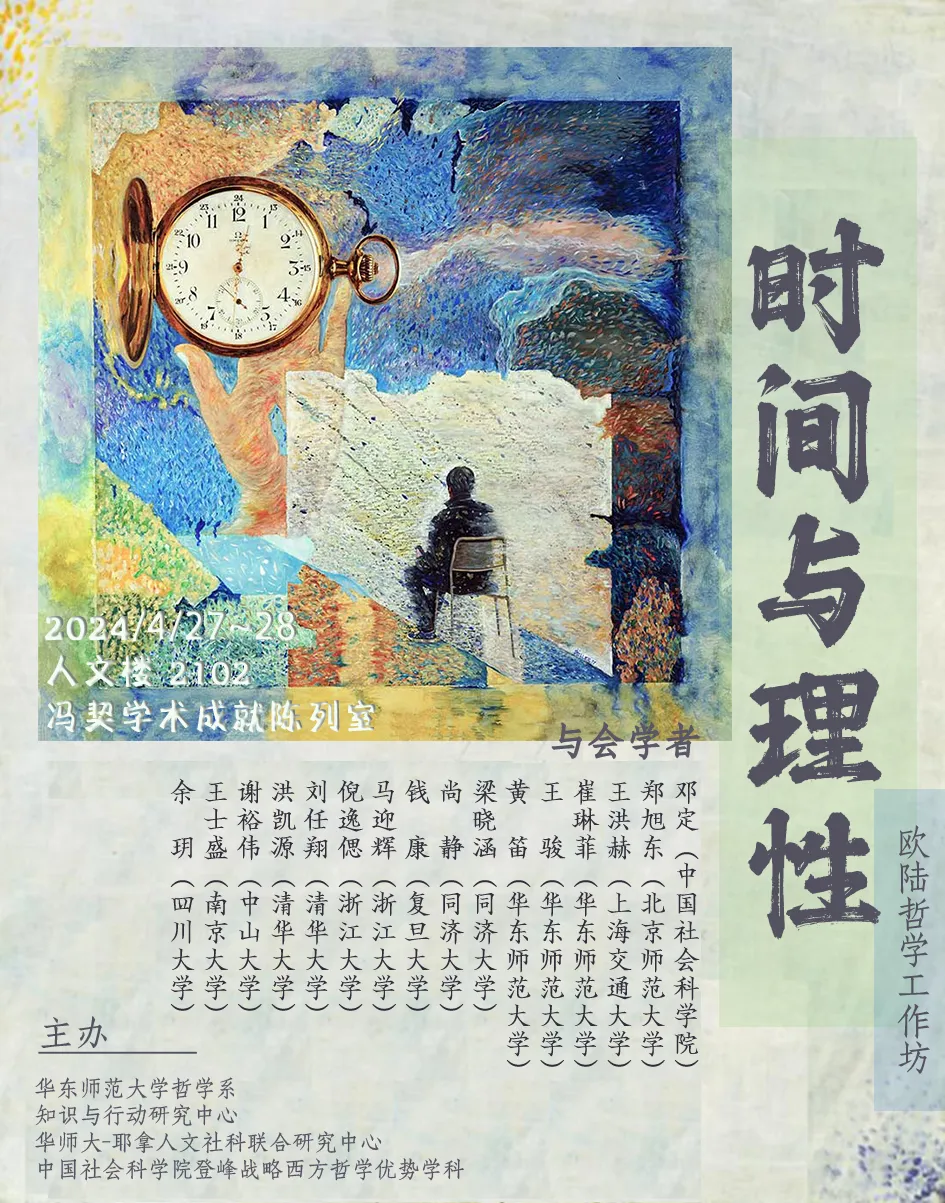


 时间小组|The Circle of Time